Batajnica

A mass grave was discovered in 2001 at the May 13 police training centre in the Belgrade suburb of Batajnica, some 20 kilometres from the centre of the Serbian capital. 

The discovery was made the year after the ousting of Yugoslav President Slobodan Milosevic’s authoritarian regime, which had ruled throughout the 1990s wars, and it was seen as a first sign from the new democratic government that it was ready to face up to Serbia’s role in the 1998-99 war in Kosovo, which saw 13,000 people killed and a million expelled, most of them Kosovo Albanians. 

The remains of 744 people were found at Batajnica, all of them Kosovo Albanians who were killed in spring 1999 in Kosovo by the Yugoslav Army, Serbian police and paramilitaries. Most of the victims were civilians, and included men, women, children and elderly people. Alongside their remains, forensic teams also found jewellery, pens, cigarette boxes, children’s marbles, calculators, various tickets and one piece of history homework. Although considered to be a single mass grave, Batajnica is a series of five mass graves and three related features. 

Some of the bodies had been transferred from primary gravesites and some from the killing sites in Kosovo to Belgrade in trucks over the course of three months in April, May and June 1999. The cover-up operation was a joint operation by the Serbian leadership, police, army and public utility services.  

As the NATO bombing of Yugoslavia was ongoing at the same time as the cover-up, the police centre in Batajnica had been abandoned because it was feared that it would be attacked by the Western military alliance. Those involved in the cover-up hoped that the mass grave would remain secret, but traces of disturbed earth and the tyre-tracks of trucks were found. 

The personnel involved in the covert operation had a pact of secrecy, but after the Milosevic regime was ousted, many decided to speak out because they feared prosecution by the International Criminal Tribunal for the Former Yugoslavia, ICTY. At the time, the ICTY had already indicted Milosevic for war crimes in Croatia, Bosnia and Herzegovina and Kosovo, and the charges included cover-up operations to conceal wartime crimes across the former Yugoslavia. Milosevic died before the verdict in his trial. 

Two ICTY judgments found several state, army and military officials guilty of covering up crimes by transporting war victims’ bodies from Kosovo to Serbia. They included Yugoslav Army officers Nebojsa Pavkovic, Dragoljub Ojdanic and Sreten Lukic, Serbian Interior Ministry officials Sreten Lukic and Vlastimir Djordjevic, and the deputy prime minister of Yugoslavia, Nikola Sainovic.

The mass grave is still within the grounds of the police centre and is not publicly accessible. All visits need to be approved by the police and access is rarely granted. Near the mass grave, a new Serbian Orthodox Church has been built, which was seen by some as an insult to the ethnic Albanian victims. There have been calls to make Batajnica a memorial centre, but this has not happened.
Ovcara Farm

The mass grave near Ovcara Farm, some five kilometres from the town of Vukovar in eastern Croatia, was discovered in 1992. The remains of 200 people were found, of whom 192 people have been identified. All of them were killed in a storage building at the farm after being seized from Vukovar hospital when the besieged town fell to the Yugoslav People’s Army and Serbian paramilitaries in November 1991.

UN officials firstly identified the Ovcara Farm mass grave in December 1992, but were not allowed to investigate. A UN mission visited the area again in 1993, but rebel Croatian Serb authorities, who controlled the area until the end of the war, again did not give them permission to investigate further.

Exhumations in the area started in August 1996 after the Croatian Serb rebel regime was ousted. The grave is ten metres long and seven metres wide and a metre and a half to two metres deep. 

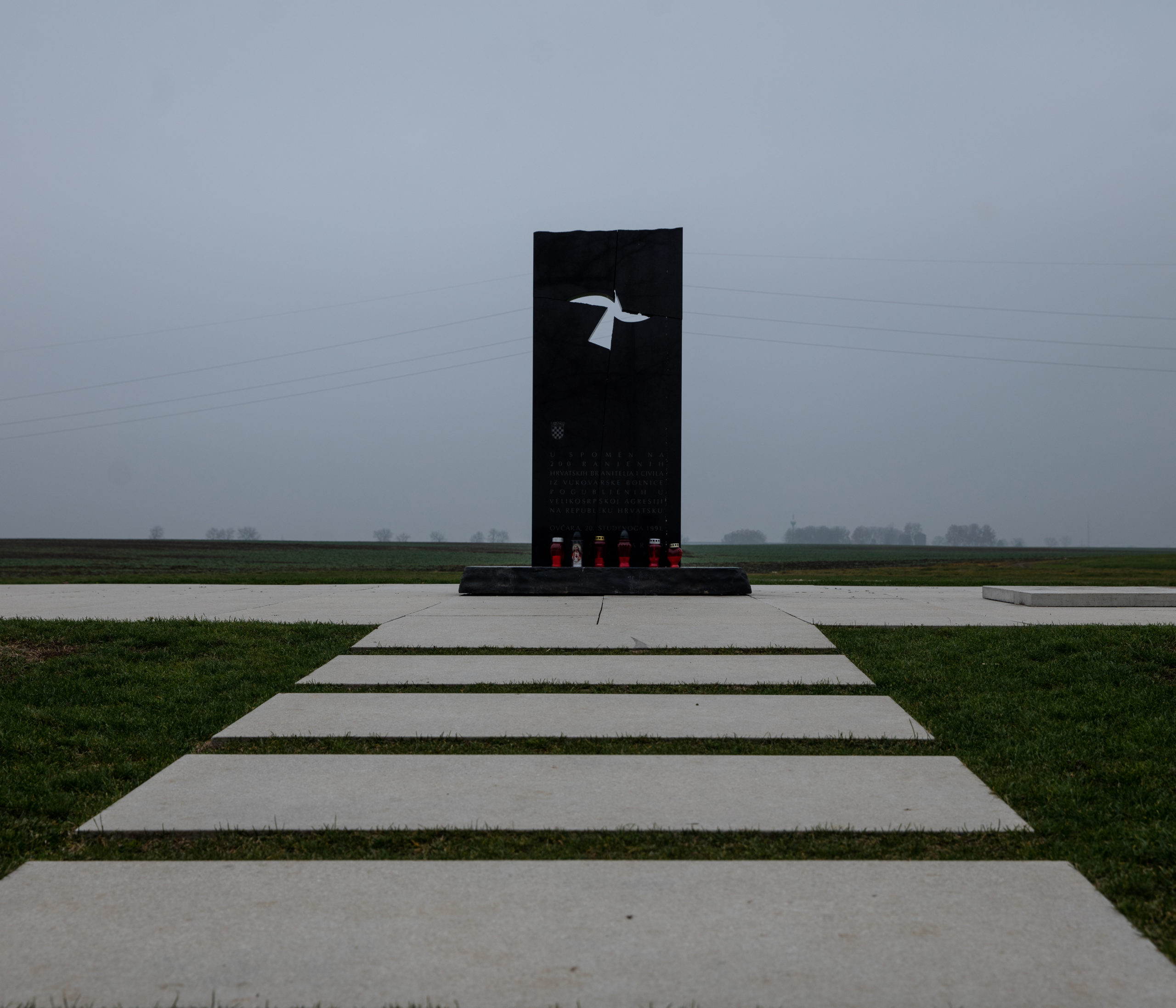
Before the war, Ovcara Farm was part of VUPIK, a state-owned agricultural company, which was privatised in 2010. The farm’s territory is now part of the state-level Memorial Centre of the Homeland War. A monument dedicated to the victims was installed in December 1998 at the spot where the mass grave was found. Two hundred bushes, each symbolising one victim, were also planted at the site in their memory. The storage building in which the mass killings took place is now the Memorial Home Ovcara, which opened in 2006.

After a three-month siege, Vukovar fell on November 18, 1991. Some of the town’s defenders went into hiding at Vukovar hospital, from where Serbian forces seized some 250 people the next day and took them to Ovcara Farm. At the farm, the prisoners were beaten and tortured in the storage building, which was guarded by Yugoslav People’s Army troops.

The troops withdrew on November 20 and Serbian paramilitaries took over, continuing the beatings and torture. That evening, the paramilitaries took the captives out of the storage building in groups of 20, and executed and buried them.

A total of 12 people have been sentenced to a total of 161 years in prison for the killings at Ovcara. The International Criminal Tribunal for the Former Yugoslavia sentenced Yugoslav People’s Army colonel Mile Mrksic, commander of the First Guards Motorised Brigade and of Operational Group South, to 20 years in prison and Yugoslav People’s Army major Veselin Sljivancanin, the security officer of the First Guards Motorised Brigade and of Operational Group South, to ten years in prison. Domestic courts in Serbia convicted ten people, members of the Leva Supoderica paramilitary unit and Serb Territorial Defence fighters from Vukovar, of participating in the crime at Ovcara.

Vukovar New Cemetery

The mass grave is located in Vukovar’s New Cemetery in the eastern Croatian town of Vukovar. It was exhumed in 1998 and the remains of 938 bodies were found, of which 859 have been identified. It is the biggest wartime mass grave in Croatia.

The bodies found in this mass grave are believed to be those of people killed during the three-month siege of Vukovar in 1991 by the Yugoslav People’s Army and Serbian paramilitaries and after the town fell, but also those of people who died of natural causes due to difficulties getting medical treatment when the town was under Serb control.

The place where the mass grave was found is now the Memorial Cemetery of the Victims of Homeland War. It consists of 938 white marble crosses, one in memory of each victim. In October 2000, a four-metre-high bronze monument was installed in the central part of the cemetery.

The mass grave was found in 1998 when Croatia regained control over its eastern territory from rebel Serbs. It was excavated from April to July 1998.

Of the 859 individuals whose remains have been identified, 644 are Croatians, and 358 of them have been classified as civilians. This is mainly a secondary mass grave, as the remains have mainly been moved from other mass graves, or even from regular cemeteries.

The Yugoslav People’s Army and paramilitary units entered Vukovar on November 18, 1991 after an 87-day siege that devastated the town. Over 200 prisoners were subsequently executed at the nearby Ovcara Farm. Most of them were buried in a mass grave at the farm, but 13 of the Ovcara victims were found in the New Cemetery mass grave.

The International Criminal Tribunal for the Former Yugoslavia did not convict anyone of crimes committed during and after the siege of Vukovar, apart from the Ovcara killings. Yugoslav President Slobodan Milosevic and Croatian Serb wartime rebel leader Goran Hadzic were indicted for persecution, forcible expulsions, murders and destruction of property during and after the siege, among other alleged crimes, but both of them died before the end of their trials.

Croatian courts have convicted a total of 20 people of crimes related to Vukovar. They were sentenced to a total of 229-and-a-half years in prison. The Higher Court in Belgrade also convicted one person and sentenced him to nine years in prison.

Lazete 2

Lazete 2 (also known as Orahovac 2) is a primary mass grave, located close to the Lazete 1 gravesite, near the village of Orahovac, north-west of the city of Zvornik.  Lazete 2 was partly exhumed by a joint team from the prosecutor’s office at the International Criminal Tribunal for the Former Yugoslavia and Physicians for Human Rights between August 19 and September 9, 1996, and the exhumation was completed in 2000. 

Analysis bу the International Commission on Missing Persons indicated that there were 188 war victims buried there, all of them male, ranging from 13 to 70 years of age at the time of their deaths. The vast majority died of gunshot wounds.

Twenty-one individuals listed as missing after Bosnian Serb forces took Srebrenica were positively identified during the first exhumation of the Lazete 2 gravesite; all of them were Bosniak men. Identification documents for a further four men listed as missing following the fall of Srebrenica were uncovered during exhumations at the site in 2000. In 1996, investigators also uncovered numerous strips of cloth at a dump in the grounds of the Grbavci school. The cloth strips were indistinguishable from the blindfolds uncovered during the exhumation of the Lazete 2 gravesite. 

The location of the mass grave is now an unmarked meadow, next to a cornfield and a railway line.

Bosniak men who had been captured from a column of men fleeing Srebrenica after it fell or who had been separated from women and children in Potocari near Srebrenica were transported on July 14, 1995 to the Grbavci school in the village of Orahovac. Forensic analysis of soil/pollen samples, evidence and aerial images of creation/disturbance dates, further revealed that bodies from the Lazete-1 and Lazete 2 graves were later removed and reburied at secondary graves named Hodzici Road 3, 4 and 5 some ten kilometres away.

A protected ICTY witness codenamed PW 101, a Bosnian Serb Army soldier, recalled that at one point during the execution of one group of men, a boy who he thought was about five or six years old stood up from the pile of bodies and began to move towards the soldiers, calling for his father. The boy was in shock and covered with blood stains and human tissue, and the soldiers lowered their rifles and froze. Their supervisor turned to them soldiers and asked what they were waiting for, telling them to “finish him off”. The soldiers replied that the “lieutenant colonel or colonel” had a weapon and that he should do it himself because they could not. The “lieutenant colonel or colonel” then ordered the soldiers to take the boy away and bring him back with the next batch of men to be killed. However, the boy was taken instead to a hospital in Zvornik, where he received treatment and ultimately survived.

During former Bosnian Serb military chief Ratko Mladic’s trial, a protected ICTY witness codenamed RM-313 said that he survived the shooting of Srebrenica Bosniaks, including his father, in Orahovac in July 1995, and that he was seven years old at the time.

The ICTY found that in the early afternoon of July 14, 1995, Bosnian Serb Army Zvornik Brigade personnel under the supervision of Drago Nikolic and Milorad Trbic transported the Bosniak men from the Grbavci School in Orahovac to a nearby field, where personnel, including members of the 4th Battalion of the Zvornik Brigade, summarily executed them with automatic weapons. 

Nikolic accompanied the trucks to and from the execution field on several occasions, while Trbic personally executed several of the victims at the field. Approximately 1,000 Bosniaks were killed. On July 14 and 15, 1995, members of the Zvornik Brigade Engineering Company used heavy equipment to bury the victims in mass graves at the execution site.

The ICTY’s trial chamber found Radislav Krstic, the Deputy Commander and Chief of Staff of the Bosnian Serb Army’s Drina Corps, guilty of genocide – its first verdict establishing that genocide was committed against Bosniaks from Srebrenica. He was sentenced to 46 years in prison although the sentence was subsequently shortened to 35 years. 

The ICTY also found that Ljubisa Beara, the chief of security of the Bosnian Serb Army’s Main Staff, was told to organise, coordinate and facilitate the detention, transportation, summary execution and burial of the Bosniak victims murdered at Orahovac. Beara was assisted by Vujadin Popovic, Drago Nikolic and Milorad Trbic, among others. 

Beara, Popovic, Nikolic and Trbic were found to have supervised, facilitated and overseen the Orahovac executions, and the ICTY convicted them of genocide. Vidoje Blagojevic, commander of the Bratunac Brigade of the Bosnian Serb Army, was sentenced to 15 years in prison for aiding and abetting the murder and persecution of Bosniaks in the Srebrenica area, as well as aiding and abetting the murder of Bosniaks in Bratunac. Dragan Jokic, chief of engineering of the Zvornik Brigade of the Bosnian Serb Army, was sentenced to nine years in prison for the murders of Bosniaks in Orahovac, at the Branjevo Military Farm in Pilica and in Kozluk, and for providing engineering resources and personnel to dig mass graves for the executed victims.

Former Bosnian Serb military chief Ratko Mladic was sentenced to life imprisonment under a first-instance verdict for the genocide of Bosniaks from Srebrenica, among other crimes.

Lazete 1

Lazete 1 (also known as Orahovac 1) is a primary mass grave located 12 kilometres north-west of the city of Zvornik, near the village of Orahovac. The Lazete 1 gravesite was first investigated in 1998 as part of Srebrenica cases and exhumed by the International Criminal Tribunal for the Former Yugoslavia, ICTY between July 13 and August 3, 2000.

Aerial photos show that the ground in Orahovac was disturbed between July 5 and 27, 1995 and again between September 7 and 27, 1995. Another primary mass grave was also found in the area, which was named Lazete 2 by ICTY investigators.

Forensic investigations showed that the gravesite was disturbed, bodies were dug up and moved to other locations in an attempt to hide the crime. It has been estimated that a total of 195 bodies were originally in the grave, and approximately 68 were removed. Strips of material tied around the head or placed over the face were recovered from 89 human remains and were probably used as blindfolds. Forensic analyses of soil/pollen samples, blindfolds, ligatures, shell cases and aerial images of creation/disturbance dates further revealed that bodies from the Lazete 1 and Lazete 2 graves were removed and reburied at secondary graves named Hodzici Road 3, 4 and 5 some ten kilometres away.

The Lazete 1 location is now an ordinary field, unmarked, with a house in ruins in the middle of the field. The main road is on the right side and on the left there’s a lane that leads to the underpass and the other gravesite, Lazete 2. Where the two roads meet, there’s a drinking fountain. One of the witnesses to the crime, a member of the Bosnian Serb Army’s Zvornik Engineering Brigade, recalled seeing dead bodies while going to get water in between breaks from digging the mass grave.

The victims who were buried at Lazete-1 had been part of a larger group of Bosniaks who were held overnight in the town of Bratunac and were then sent in a convoy of 30 buses to the Grbavci school in Orahovac in the early morning of July 14, 1995. When they arrived, the school gym was already half-full of prisoners who had been brought in since the early morning. ICTY testimony suggests there may have been around 1,000 people detained in the school, while survivors estimated that there were around 2,000. Some of the prisoners were taken outside and killed. One witness said that Ratko Mladic arrived on the day on which there were executions outside the school. 

The ICTY found that in the late evening of July 13, 1995 and during the day on July 14, Drago Nikolic and Milorad Trbic, working together with personnel from the Military Police Company of the Zvornik Brigade and Military Police Platoon of the Bratunac Brigade, under the supervision of Vujadin Popovic and Ljubisa Beara and under orders from their superior command, including the Deputy Commander of the Zvornik Brigade, Dragan Obrenovic, organised and facilitated the transportation of hundreds of Bosniak males from in and around Bratunac to the Grbavci School in Orahovac, with knowledge that those prisoners were to be collected and summarily executed. 

In the early afternoon of July 14, 1995, Zvornik Brigade personnel under the supervision of Nikolic and Trbic then transported the prisoners from the Grbavci School in Orahovac to execution sites less than one kilometre away, where they were lined up and shot in the back by personnel including members of the 4th Battalion of the Zvornik Brigade. Those who survived the initial gunfire were killed with an extra shot. Two adjacent meadows were used; once one was full of bodies, the executioners moved to the other. While the executions were in progress, earth-moving equipment was already digging the graves, survivors said. A protected ICTY witness codenamed Witness N, who survived the shootings by pretending to be dead, reported that Mladic drove up in a red car and watched some of the executions.

Nikolic accompanied the trucks to and from the execution field on several occasions, while Trbic personally executed several of the victims himself. Approximately 1,000 Bosniak men were killed. On July 14 and 15, 1995, members of the Zvornik Brigade Engineering Company used heavy equipment to bury the victims in mass graves at the execution site. 

The ICTY’s trial chamber found Radislav Krstic, the Deputy Commander and Chief-of-Staff of the Bosnian Serb Army’s Drina Corps, guilty of genocide – its fisrt verdict establishing that genocide was committed against Bosniaks from Srebrenica. He was sentenced to 46 years in prison although the sentence was subsequently shortened to 35 years. 

The ICTY also found that Ljubisa Beara, the chief of security of the Bosnian Serb Army’s Main Staff, was told to organise, coordinate and facilitate the detention, transportation, summary execution and burial of the Bosniak victims murdered at Orahovac. Beara was assisted by, among others, Vujadin Popovic, Drago Nikolic and Milorad Trbic. 

Beara, Popovic, Nikolic and Trbic were found to have supervised, facilitated and overseen the Orahovac executions, and the ICTY convicted them of genocide. Vidoje Blagojevic, commander of the Bratunac Brigade of the Bosnian Serb Army, was sentenced to 15 years in prison for aiding and abetting the murder and persecution of Bosniaks in the Srebrenica area, as well as aiding and abetting the murder of Bosniaks in Bratunac. Dragan Jokic, chief of engineering of the Zvornik Brigade of the Bosnian Serb Army, was sentenced to nine years in prison for the murders of Bosniaks in Orahovac, at the Branjevo Military Farm in Pilica and in Kozluk, and for providing engineering resources and personnel to dig mass graves for the executed victims.

Former Bosnian Serb military chief Ratko Mladic was sentenced to life imprisonment under a first-instance verdict for the genocide of Bosniaks from Srebrenica, among other crimes.

Cerska

Cerska is a primary grave in the Cerska Valley on the main road from Konjevic Polje to Nova Kasaba, 27 kilometres north-west of the town of Srebrenica. It was discovered and exhumed in July 1996 by the International Criminal Tribunal for the Former Yugoslavia, ICTY as it collected evidence relating to the Srebrenica genocide by documenting injuries, identifying the times and causes of death of the victims and corroborating witness testimonies.The identification process was led by the Federal Commission for Missing Persons (later known as the Missing Persons Institute).

The grave was undisturbed and contained 150 remains of male victims of ages estimated to range from 14 to 50 years at the time of death. One witness to the killings said that on July 13, 1995, three buses full of male prisoners were seen being driven along the road in the direction of the Cerska valley, followed by an armoured personnel carrier. Shortly afterwards, intensive shooting was heard and a digger was then seen entering the walley. 

The Cerska mass grave was identified in July 1995 using aerial images of an embankment on the south-west side of the road. The aerial images show there were no signs of disturbed earth at the site before July 7, 1995, but footage captured on July 27 shows a new mound of earth has appeared, indicating digging at the site.

The location of the mass grave, next to the road and a few houses in the village of Macesi, around four kilometres from Konjevic Polje, remains unmarked. 

The evidence found at the site indicated that the victims’ wrists were bound behind their backs with wire ligatures. It appeared from the location of shell casings that they were placed on the roadside while their executioners stood across the road. Soil from the north-east side of the road was used to cover the bodies where they fell. 

Of the 150 victims, only one was not killed by gunshots. The hands of 24 victims were tied, and many more lengths of wire were found near other remains. A total of 147 of the victims were dressed in civilian clothing. ICTY investigators collected approximately 189 shell casings from the surface of the ground at the site and 67 more were discovered during the exhumation and autopsy process. 

Expert witness Dusan Janc at the Radovan Karadzic trial explained that the Cerska gravesite contained not only victims from Kravica warehouse where more than 1300 Bosniaks from Srebrenica were killed, but also victims from the Bratunac school building and bodies of people, who were killed alongside the main road leading to Bratunac.

A protected ICTY witness codenamed Witness M’s eyewitness account of the crime, which said that buses followed by an earth loader drove up the Cerska Valley road into a wooded area, roughly corresponds in time to intercepted communications on July 13, 1995 in which Colonel Milanovic, the Chief of Anti-Aircraft Defence of the Bosnian Serb Army’s Drina Corps, asked for engineering equipment to be sent to Konjevic Polje.

The ICTY’s trial chamber in the case against the Deputy Commander and Chief of Staff of the Bosnian Serb Army’s Drina Corps, Radoslav Krstic, did not consider the evidence and this account sufficient to implicate the Drina Corps in the Cerska Valley executions on July 13.

Krstic however was found guilty of genocide in the first ICTY verdict to establish that genocide was committed against Bosniaks from Srebrenica. He was sentenced to 46 years in prison, although the sentence was subsequently shortened to 35 years.

Crni Vrh

Crni Vrh is a secondary mass grave that was discovered in 2003 near the village of Snagovo, 16 kilometres south-west of the city of Zvornik. It is one of the largest mass graves to have been discovered in Bosnia and Herzegovina – more than 40 metres long, five metres wide and three metres deep. The remains of 629 bodies were exhumed from the grave by the International Commission on Missing Persons, the Bosnian Prosecutor’s Office and the Bosnian Missing Persons Institute, while 537 were identified. 

The remains of the victims buried at Crni Vrh had been transferred from at least two primary graves elsewhere in an attempt to hide the traces of their killings. They were found to be men, women and children from villages in the Zvornik area who were killed in 1992. They are thought to have been moved from their initial resting places in 1995 or early 1996. Some of the victims were found in Yugoslav People’s Army body bags, as were bodies found at the Ramin Grob gravesite. 

The gravesite at Crni Vrh remains unmarked, next to a mountain lane, surrounded by woods and scattered garbage. The local rubbish dump is located a few hundred metres away from the gravesite. Within walking distance from Crni Vrh, there are numerous secondary mass graves, such as gravesites along the Hodzici Road that are connected to the Srebrenica executions. 

Among the remains found at the site were those of the Ribic family, who were of Roma origin. According to the Bosnian Missing Persons Institute, nine members of the Ribic family were killed, including children, the youngest of whom was two. The killers were identified as members of a paramilitary unit from Serbia called Sima’s Chetniks, led by Sima Bogdanovic. The Belgrade Court of Appeals acquitted six members of the Sima’s Chetniks unit for killing 27 Roma civilians. But three of them – Zoran Alic, Zoran Djurdjevic and Tomislav Gavric – were convicted of inhumane treatment, violation of physical integrity, sexual humiliation and rape. Simo Bogdanovic died during the trial.

Some of the victims identified at Crni Vrh were killed at the Celopek Culture House, near Zvornik, which was used as a detention facility for Bosniaks from the village of Divic from May to July 1992. The detention facility was run by the Yellow Wasps paramilitary unit, the Bosnian Serb Army and the Zvornik Territorial Defence force. The White Eagles paramilitary unit frequently visited the facility and tortured, sexually abused and executed detainees.

At the trial of Serbian Radical Party leader Vojislav Seselj at the International Criminal Tribunal for the Former Yugoslavia, ICTY, a protected witness testified that he had seen two lorries driving from Karakaj near Zvornik to Crni Vrh. The witness followed the lorries and saw an already prepared grave into which 30 to 50 male bodies were unloaded. He also saw a number of  arms and legs being unloaded into the grave.

At the trial of former Yugoslav President Slobodan Milosevic at the ICTY, a protected witness codenamed B-1775, one of the men responsible for the transportation of bodies from the Zvornik area to mass graves, testified that bodies from the Ramin Grob gravesite were dug up by Bosnian Serb forces and then transported to the secondary gravesite at Crni Vrh in an attempt to conceal the crime. The witness was also involved in transportation of bodies from Zvornik to other locations on the order of a member of a paramilitary unit called the Serbian Volunteer Guard, better known as the Tigers, led by Zeljko Raznatovic, alias Arkan.

The ICTY convicted Mico Stanisic, the wartime interior minister of Republika Srpska, and Stojan Zupljanin, chief of the Bosnian Serb police’s Banja Luka Security Services Centre, of committing crimes in 20 Bosnian municipalities including Zvornik in 1992, and sentenced them to 22 years in prison. 

The Serbian Supreme Court in 1998 sentenced Dusan Vuckovic, leader of the Yellow Waps paramilitary group, to ten years in prison for killing 16 Bosniak civilians and wounding 20 others at the Cultural Centre in Celopek on June 28, 1992. Vuckovic was indicted again in 2005, alongside six other suspects, for committing war crimes in Zvornik and the surrounding area against civilians from early May to mid-July 1992, but the proceedings against him were terminated after he was found dead in prison. His five co-defendants were convicted, however: Darko Jankovic was sentenced to 15 years in prison, Dragan Slavkovic to 13 years, Ivan Korac to nine years, Sinisa Filipovic to three years and Goran Savic to 18 months.


Ramin Grob

Ramin Grob (also known as Glumina) is a primary mass grave located in the village of Glumina, some eight kilometres north-west of the city of Zvornik. The gravesite was found in the grounds of an existing Muslim cemetery called Ramin Grob. In October 1998, the Bosnian Missing Persons Commission exhumed the remains of 274 individuals from the gravesite, while 271 were identified.

According to the Missing Persons Commission, more than 700 people were reported missing from Glumina and several nearby villages in early 1992 and were suspected to have been killed and buried in the vicinity. Witnesses reported that during a two-to-three-week period in April 1992, several large trucks were seen coming to the Ramin Grob cemetery, and numerous large, dark-coloured bags were removed from the trucks. Their description of these bags was consistent with the bags discovered at the Ramin Grob gravesite. The bags bore the insignia of the Yugoslav People’s Army, JNA. Of the exhumed bodies, 208 were found buried in body bags, while the remaining 66 were not. 

The cause of death determined by forensic pathologists was gunshot wounds in 246 of the 274 cases. All of the bodies found, two females and 272 male, wore civilian clothing. The ages of the identified bodies ranged from 14 to 80 years, and they came from Glumina and the nearby villages of Drinjaca, Kostijerovo and Musici. 

In 2016, 20 bodies exhumed from the site were buried as anonymous victims, as no one was able to identify them. The Ramin Grob gravesite remains unmarked. 

A protected witness codenamed B-1775, one of the men responsible for the transportation of victims’ bodies from the Zvornik area to mass graves, testified at the trial of former Yugoslav President Slobodan Milosevic at the International Criminal Tribunal for the Former Yugoslavia, ICTY that some bodies from Ramin Grob were dug up by Bosnian Serb forces in an attempt to cover up the crime and then transported to a secondary gravesite Crni Vrh. The witness was also involved in transportation of bodies from Zvornik to other locations on the order of a member of a paramilitary unit called the Serbian Volunteer Guard, better known as the Tigers, led by Zeljko Raznatovic, alias Arkan.

At the trial of former Yugoslav President Slobodan Milosevic at the ICTY, a protected witness codenamed B-1455, who was held captive with other Bosniaks at the Cultural Centre in Drinjaca, near Zvornik, which was used as a detention facility by the Bosnian Serb Army’s Zvornik Brigade in May 1992, recalled seeing members of Arkan’s Tigers entering the room and beating people for several hours. The same day, after Arkan’s paramilitaries left, the witness recalled members of another paramilitary unit, the White Eagles, abusing and torturing the detainees and then taking groups outside to execute them. The witness survived but his father and three brothers were among those killed, and their bodies were exhumed from the Ramin Grob gravesite in 1998. 

Belgrade Higher Court sentenced two former Territorial Defence forces fighters in Zvornik, Branko Grujic and Branko Popovic, to six and 15 years in prison respectively for war crimes against civilians in the Zvornik municipality in 1992. The Bosnian state court is currently trying Cvijan Tomanic for taking part in the persecution and killings of the Bosniak civilians in Zvornik as a member of the Bosnian Serb Army’s Zvornik Brigade. The Bijeljina District Court acquitted Milan Ignjatovic of participating in the shootings at the Cultural Centre in Drinjaca.

Verdicts handed down by the ICTY, the Bosnian state court and Belgrade Higher Court have sentenced political leaders of Republika Srpska, the president of Zvornik’s interim municipal government and 17 Bosnian Serb Army soldiers, including one commander, to a total of 186 years and nine months in prison, plus two life sentences, for wartime crimes in the Zvornik area. No member of Arkan’s Tigers has been convicted of crimes in Zvornik.

Hrastova Glavica

Hrastova Glavica is an underground cave located about 15 kilometres from the town of Sanski Most in north-west Bosnia and Herzegovina. The remains of 121 victims of a massacre that took place on August 5, 1992 were identified. All but two of them were detainees from the Keraterm and Omarska camps near Prijedor; the other two are believed to have been killed during World War Two. 

In 1992 detainees were taken by buses to Hrastova Glavica, where they were killed and thrown in a pit that was about 20 metres deep. They had previously been tortured at the Keraterm and Omarska camps. 

In 2012, the Izvor Association of Prijedor Women and the Association of Former Camp Prisoners from Sanski Most installed a memorial to the victims at the Hrastova Glavica cave. It includes two plaques bearing the names of those killed in 1992 and the two victims from World War Two.

The location was discovered due to the only survivor of the massacre, Ibrahim Ferhatovic, who was later killed by Bosnian Serb forces, but before his death he managed to tell the story of the massacre to someone who later testified as a protected witness at the International Criminal Tribunal for the Former Yugoslavia. 

Bosnia and Herzegovina’s Missing Persons Commission, together with the Physicians for Human Rights, recovered the victims’ remains from the underground cave in December 1998. According to the forensic report, all victims were males between 17 and 60 years of age and most had skeletal evidence of gunshot trauma. A lot of clothing was found, mostly civilian. 

So far, 37 Bosnian Serbs have been sentenced to a total of 617 years in prison for crimes committed during the war in the Prijedor area. Among them was Milomir Stakic, the wartime president of the Serb-controlled Prijedor municipality Crisis Staff and head of the Municipal Council for National Defence in Prijedor, who was sentenced to 40 years in prison.

Koricani Cliffs

The Koricani Cliffs on Mount Vlasic in central Bosnia and Herzegovina were both a site for killings and a clandestine gravesite used by Bosnian Serb forces during the war in 1992. The remains of 177 people, mostly Bosniaks and Croats, have been identified in four exhumations carried out between 2003 and 2017. 

The cliffs, above a ravine 300 to 400 metres deep, lie on the road between the towns of Travnik and Prijedor in territory considered to be a key stronghold of the Bosnian Serb Army for much of the war. 

Since the war, there have been several attempts to mark the location of the mass grave by families of the victims, but plaques have always subsequently been removed. Each year, families commemorate the dead by throwing roses into the ravine.

On August 21, 1992, a large group of civilian detainees from the Trnopolje prison camp were being transported by Bosnian Serb forces to Bosnian government-controlled territory in Travnik. As the convoy reached Mount Vlasic, about 200 unarmed men were taken out and executed. Only 12 of them survived. 

As the ravine is so deep, the terrain was extremely difficult for investigators to exhume the bodies, and only partial remains of many victims were found. 

The International Criminal Tribunal for the Former Yugoslavia convicted Darko Mrdja, a member of the so-called intervention squad, a Bosnian Serb special police unit in the town of Prijedor, of directly participating in the unloading, guarding, escorting and shooting of the unarmed men at Koricani Cliffs. Mrdja pleaded guilty and apologised to the victims. 

Domestic courts in Bosnia and Herzegovina also prosecuted several cases linked with the killings at Koricani and convicted police officers Marinko Ljepoja, Radoslav Knezevic, Zoran Babic, Milorad Skrbic, Dusan Jankovic, Zeljko Stojnic and Sasa Zecevic. 

Prijedor is the area with the largest number of convicted war criminals in Bosnia and Herzegovina. A total of 37 Bosnian Serbs have been found guilty of committing crimes in the area and have been sentenced to a total of 617 years in prison.