
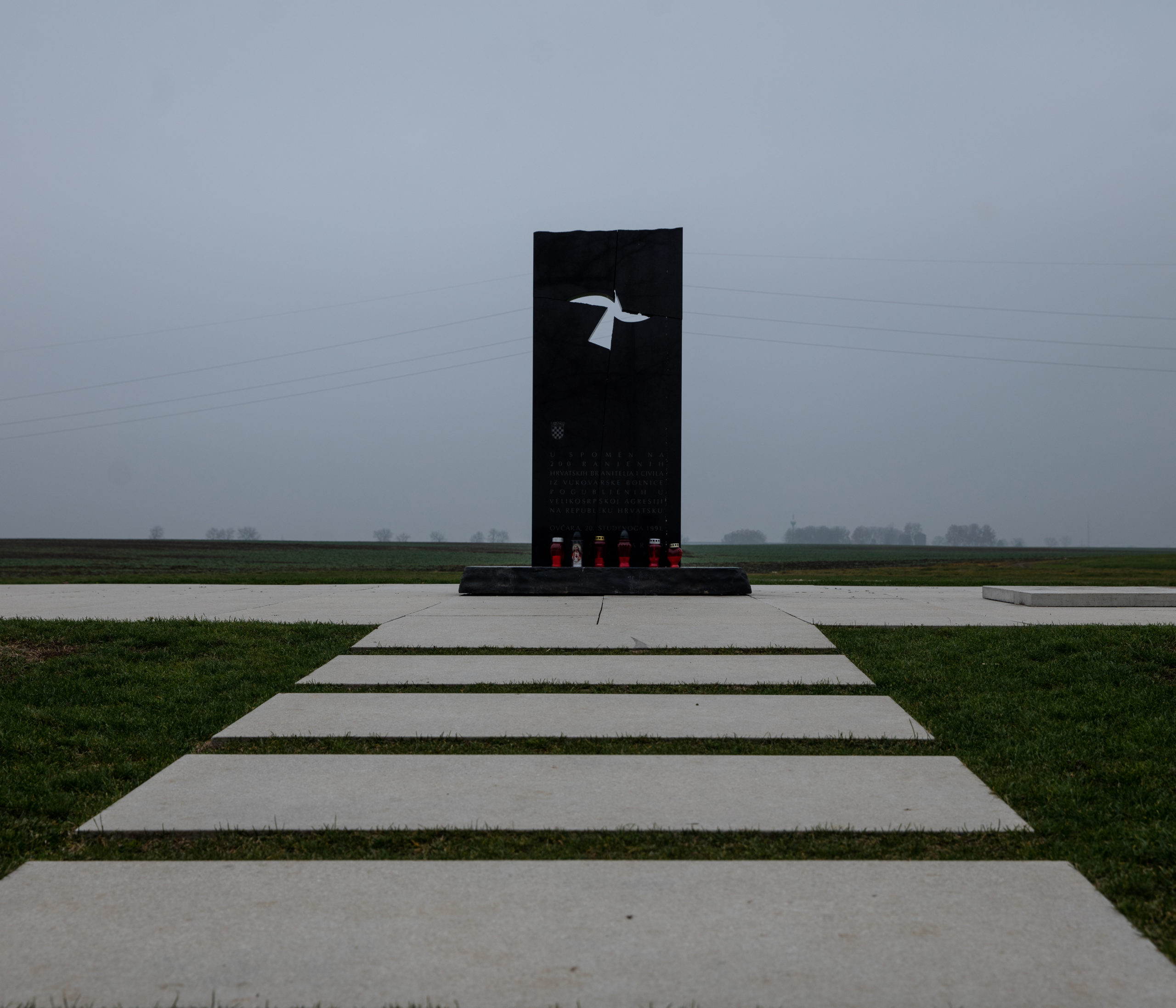
The mass grave near Ovcara Farm, some five kilometres from the town of Vukovar in eastern Croatia, was discovered in 1992. The remains of 200 people were found, of whom 192 people have been identified. All of them were killed in a storage building at the farm after being seized from Vukovar hospital when the besieged town fell to the Yugoslav People’s Army and Serbian paramilitaries in November 1991.
UN officials firstly identified the Ovcara Farm mass grave in December 1992, but were not allowed to investigate. A UN mission visited the area again in 1993, but rebel Croatian Serb authorities, who controlled the area until the end of the war, again did not give them permission to investigate further.
Exhumations in the area started in August 1996 after the Croatian Serb rebel regime was ousted. The grave is ten metres long and seven metres wide and a metre and a half to two metres deep.
Before the war, Ovcara Farm was part of VUPIK, a state-owned agricultural company, which was privatised in 2010. The farm’s territory is now part of the state-level Memorial Centre of the Homeland War. A monument dedicated to the victims was installed in December 1998 at the spot where the mass grave was found. Two hundred bushes, each symbolising one victim, were also planted at the site in their memory. The storage building in which the mass killings took place is now the Memorial Home Ovcara, which opened in 2006.
After a three-month siege, Vukovar fell on November 18, 1991. Some of the town’s defenders went into hiding at Vukovar hospital, from where Serbian forces seized some 250 people the next day and took them to Ovcara Farm. At the farm, the prisoners were beaten and tortured in the storage building, which was guarded by Yugoslav People’s Army troops.
The troops withdrew on November 20 and Serbian paramilitaries took over, continuing the beatings and torture. That evening, the paramilitaries took the captives out of the storage building in groups of 20, and executed and buried them.
A total of 12 people have been sentenced to a total of 161 years in prison for the killings at Ovcara. The International Criminal Tribunal for the Former Yugoslavia sentenced Yugoslav People’s Army colonel Mile Mrksic, commander of the First Guards Motorised Brigade and of Operational Group South, to 20 years in prison and Yugoslav People’s Army major Veselin Sljivancanin, the security officer of the First Guards Motorised Brigade and of Operational Group South, to ten years in prison. Domestic courts in Serbia convicted ten people, members of the Leva Supoderica paramilitary unit and Serb Territorial Defence fighters from Vukovar, of participating in the crime at Ovcara.
